How to grow and multiply anthurium
Varieties of Anturium. Flower care at home. Reproduction of Anturium. Protection against diseases and pests
Rod Anthurium is the most numerous of the Aoid family. The name of the genus happened from Latin words «tail» and «flower».
Plant Features
 According to various sources, there are from 500 to 900 species. Here include grassy evergreen plants, and liana, but in most – epiphytes growing on trees in tropical forests, having air roots, which descend to the forest litter.
It is worth noting that among them there are lithophytes that can live in stony and rock rocks. Anthurium, or male happiness, originally from Central and South America.
Their leaves can be of different shapes: a shovel, round, heart-shaped, dissected. The surface is like matte and glossy. Living in a rainforest can turn the leaves behind the sun.
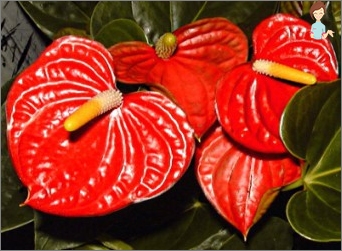
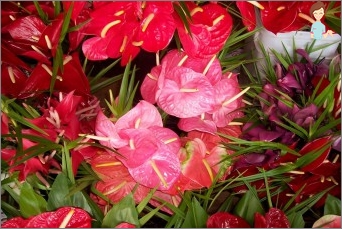
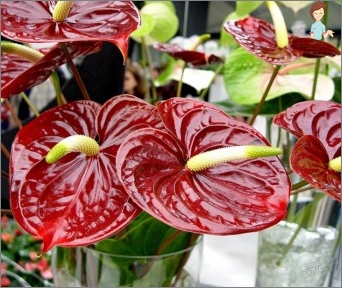
The highlight of this plant are peculiar flowers. They are presented in the large spectrum of shades – ranging from dense saturated red and ending with snow-white, there are lilac, burgundy, even green. The most common is the red anthurium.
In indoor culture, brought varieties with multicolored and black bracts. Bright color bedspread is located on inflorescence, which can have a cone-shaped, male-shaped, spherical or spiral form of different colors. Flowers themselves in appearance are similar to squares and diamonds, tightly located on the cob.
It is worth noting that the smells of colors differ depending on the species – ranging from the barely tangible and ending with a fairly concentrated aroma, and in some cases it can be even unpleasant and silent.
Than Anthurium attracts gardeners?
Male happiness, as it is more often called people, has the ability to bloom year-round, but only subject to sufficient lighting. At the same time, flowers stay on the plant long enough, sometimes up to one and a half months. If you pollinate them, you get ripe fruit – berries with two seeds having yellow or orange.
Like any other plant, they are aging over time, lose aesthetic appearance, their leaves are becoming smaller, the trunk – dry with the residues of the cuffs. Even careful care for the anthurium will not help return the former beauty.
Anthuriums have a very beautiful and spectacular appearance, differ in originality. That is why photodizainers like to use them for registration of interior of offices and apartments.
Peculiar flowers are well suited for cutting.They stand in water an average of 4 weeks, and even longer. This allows them to use them for a variety of color compositions.
At home as a room plant most often found Anthurium Andre and Sherecer.
Anthurium Andre is a large plant. Has big leaves on long stiff. His stems are covered with numerous air roots. It has a leathery, heart-shaped bubble bedspread with well-visible veins. Its color can be white, yellow, pink, red or green.
Anthurium Shercesra refers to epiphytes, has shortened stems. Typically, a plant is no more than 40 cm. Heathing from him leathery, matte, dark green, covered with small black dots. Inflorescences are often towers over the plant. Covered dense, rich red, but may have another color.
Among the plants kind there are those that grow as decoratively deciduous. For example, at home, anthurium Crystal. His main highlight is the leaves. Their color changes with age: first they are bronze-purple, and then become dark green.
They have a heart-shaped shape, a velvety surface with silver veins, reach 20 cm long. Cryatry Cryatrical Cryatural Green, Sometimes Purple Slightly.
Also often occurs anthurium magnificent. In appearance, it is very similar to the previous representative – a beautiful low-grade plant with a large sheets of dark green color, which have velvet sings and white veins.
Caring for flower anthurium at home
 It is worth noting that this is a rather whimsical view that is difficult to grow in the apartment. Many can live only in heated greenhouses.
Another feature of the care is that it contains substances that can irritate the mucous membrane, so it is necessary to be extremely neat:
- Lighting. It is impossible to set them under direct sunlight, it is better to give preference to bright scattered light or half. So that flowering happened in the winter season, it is necessary to maintain additional highlighting. At the same time, the plants are shadowed. They can be put on the northern windows, but they will not bloom in this case;
- Temperature mode. It is worth remembering that these are tropical plants, so the ideal temperature for them will be 20-25 degrees. During the cold season, decline is allowed to 16-18. Sharp oscillations and drafts should be avoided, they adversely affect the flower;
- Watering should be regular. It uses warm water. In the warm season is allowed once every 3-4 days, in winter – once a week. They are very demanding to the correct watering, do not tolerate stagnation of water and punching the soil. After watering after some time, extra water from the pallet you need to merge. You can not use cold and lime fluid for these purposes. Anthurimums need an acid substrate, and if the water will contain lime, their leaves will yellow;
- Anthurium Transplantation. Young transplant once a year, in spring. Adults – every couple of years. Pot chosen wide but shallow. It is also necessary good drainage. Do not take too large tanks because the plant will stop blossoming. The transplant must be carried out extremely gently so as not to damage the roots and leaves;
- Air humidity. Anthurium flower Rode from wet rainforests, so prefers high air humidity. It is necessary to spray the leaves, but at the same time not to touch the inflorescences, otherwise they will cover spots and fall. You can also put closer to the stems in the pot of Moss Sfagnum, which will give moisture to air roots and contributes to their growth;
- The feeding is recommended during the growth period, as well as twice a month during flowering. Use better organic fertilizers or mineral solution;
- The soil. The optimal option will be a mixture of sand, peat, humid and unexedicated leaf land. Prepare it in the ratio of 0.5: 1: 2: 1. You can add pieces of charcoal, moss, cones, pieces of broken bricks. The rough fraction should be up to 15% of the total soil. This will increase water and air permeability. The soil reaction should be weakly acid.
Reproduction of Anturium
Correct care is a guarantee that the flowers will appear constantly. In addition, numerous shoots with roots will appear.
Flower can be grown independently, that is, using seeds. To get the latter, you need to think about the action plan in advance: pollinate flowers with a cotton wand or tassels. The procedure is repeated for several days. However, fruits will appear only during the year from the moment of pollination.
After they are received, you need to put them correctly:
- Remove the seeds of fruits and rinse under running water;
- Put into a solution of manganese (0.1%) for 2 hours. Such an event will prevent the development of mold;
- Seeds are able to quickly lose similarity, so they are placed on a wet foam rubber in a shallow ass, covered with polyethylene or glass;
- After they sprouted, they are picked (3-4) several times in specially prepared soil, regularly increasing the distance between them by 1-2 cm;
- When the seedlock reaches 7 cm in diameter, it is transplanted in a pot, volume 200 ml.
Common diseases
 Basically «Male happiness» Do not consider painful. Most problems are caused by unsuitable departure. If dark dots or stains appeared on the leaves (not counting the types for which they are characteristic), then the problem is associated with low temperatures. It is necessary to rearrange the pot into a warmer place or cut watering.
Dry and yellow leaves? When it happens in winter and amazed only the edges, then the reason in the lack of light or, on the contrary – in its excess. You need to correct the lighting. The tips of the leaves are black – the soil contains many salts of calcium. In this case, a transplant is required to another soil.
To protect yourself from pests, you need to wash regularly and wipe the leaves. A competent and responsible approach to cultivation will enjoy the famous «Flamingo flowers» For most of the year.