Anthurium
Anthurium is a beautiful plant, but for it throughout the year you pleased you, you need to know somewhat important
Belongs to the aid family. Anthurium has many species. One of the most common is Anthurium Andraeanum Linden Ex Andre)
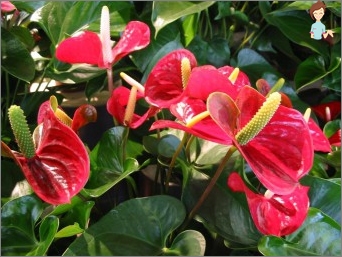
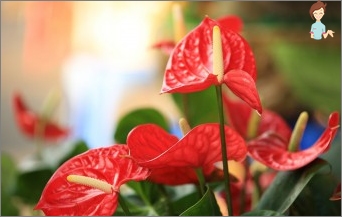
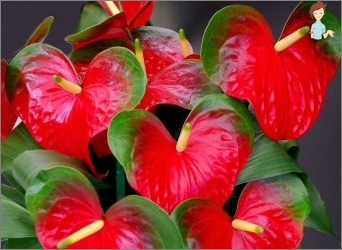 This is one of the few species that, with proper care, blooms all year round. His homeland South-West Columbia, North-Western Ecuador. Home Anthurium is a plant with shortened stem, air roots. Large dense leaves, in the form of oblong hearts, dark green, on long cuttings. Flowers with white or yellowish cylindrical.
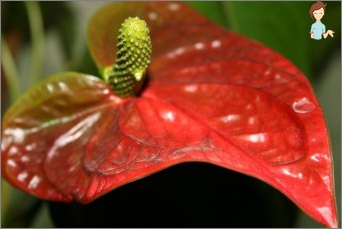
Flower bedspread is very dense, glossy, brightly painted, leathery structure. Heart shape.
Color varies, from gently pink, to bright red. Anthurium flowers create the illusion that they are made of plastics. What gives him mythical beauty. This exotic plant will complement your unusual view any interior. But it is worth being attentive, Anthuriums, like all the aid, poisonous. So if you have animals or small children, the flower should stand high, out of the reach of them.
Care for anthurium
Anthuriums do not like bright midday light. Moreover, open sun rays can become for
His destructive. But he feels great with the scattered light, and tolerates it well. For him, north-western windows are optimal. Anthurium-flower that does not tolerate sharp fluctuations in temperature and draft.
 It needs constant temperature mode. The optimal temperature in the summer is 25-28 ° C, in the winter period not lower than 18 ° C.
If you want Anthurium to bloom before, then you need to smoothly increase the temperature to 20-25 ° C since January. Anthurium needs abundant irrigation. But there is a lot «but»!
It is very important that the Earth between the glands of survived on 1/2 pot. Otherwise the roots can simply burn. After watering water from the pallet, it is necessary to immediately pour. In order for the bloom to be abundant since September reduce the irrigation interval.
This plant prefers very wet air (70-90%). This is the most frequent problem in the home breeding of Anthurium. In the residential premises it is very difficult to achieve such a percentage of humidity. Therefore, the stalks of the plant, namely where there are air roots, it is recommended to run moss, and from time to time spray it.
During flowering, spray anthurium is needed very carefully, so that the water does not fall on the flowers. Otherwise, dark spots are formed on the flower bedspread. Water for watering should be soft and not cold. The substrate for anthurium should be loose, deeply fibrous and little acidic. Good mixtures of peat, chopped moss and turf (2: 2: 1), or deciduous land, peat and sand with the addition of charcoal.
Transfer
 Like other plants, Anthurium should be transplanted during the growth period, from February to August. When transplanting must be extremely careful with the roots, they are very fragile, it is easy to damage.
Young plants transplant every year, more adults every 3-4 years.Transplanting, Anthurium put a little deeper into the ground than it was planted earlier. On the bottom of the pot about 1/3 be sure to put drainage. Most often ceramzit.
And do not water the plant for a few days.
Fertilizers
Undercumation is carried out in springtime, 1 time in 2-3 weeks. But the most effective extraordinary feeding. They are applied to the leaves, 1 time per week.
Reproduction
 More successful anthurium breeding vegetatively. That is, stabbed siblings, steels with air roots.
Cuttings are easily separated from the main stem, they often have good roots.Such siblings should immediately put in the pot of the corresponding size.
If the plant has 5-6 leaves, the size of the pot is approximately 9-10 cm. In diameter.
Diseases and pests
Anthurium suffers from shields, milders, cute ticks, tool. Especially dangerous shields, they quickly breed, and cure the plant is quite difficult.
The main diseases are root rot and anthracnose. The antraznosis begins with the yellowing of the edges of the leaves and leads to a gradual gradiment of the plant.
It is necessary to carry out preventive processing of fungicides.