Imit a stone with your own hands: step-by-step guide
Imitation of the stone with their own hands – an excellent option for decorating and designing the room both inside and outdoor. If desired, simple techniques can master each
The stone in the decoration of the premises is used for several thousand years. Today, natural material is quite expensive, so the technology of making artificial stone is improved every year. If you know some secrets, the final result will not differ from expensive options.
Numerous technologies developed by experts allow you to copy practical any natural material. In addition, it is not necessary to have special conditions for manufacture, you can do everything right at home.
Types of artificial stone
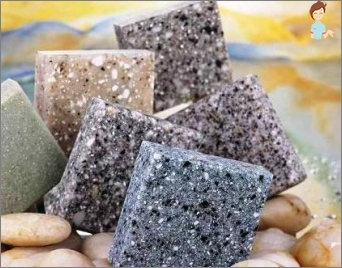 Create material from different components, which allows you to achieve the desired effect.
The most popular today are such materials:
- Ceramic tile. For production, clay is used, which after forming amenable to burning;
- Gypsum tile. It is used only for finishing internal surfaces;
- Concrete plate. You can use both on the inside of the building and outside;
- Acrylic material. Stand out among others with its increased strength. Similar polyacryl coating is most often used to imitate marble.
How to make a stone laying imitation do it yourself?
Many for the design of the room often stop their choice on brickwork. Imitation can be carried out in several ways, for example, to buy appropriate wallpapers, use gypsum or ceiling plates. We offer to stay at the option that even a woman can cope with. It is based on the use of corrugated cardboard.
Required material:
- Corrugated cardboard. You can use dense boxes remaining from home appliances;
- Tight napkins with brick pattern. Do not save, buy high-quality options;
- PVA glue;
- Glue pistol;
- Varnish and paint.
The surface where the work will be held, it is necessary to clean from old wallpaper and brew. If there was paint there, it is worth removing it, and the surface is degreed.
Now cut from the cardboard rectangles, the size of which should match the side of the brick. To conveniently make a laying, it is recommended to carry out basic horizontal lines on the wall. Otherwise, the result may be uneven, and work will have to redo.
Each prepared rectangle pretty wake PVA in the center, and in the corners will be held hot glue from the gun. Due to this, the detail literally instantly locks on the wall. Do all this with other cardboard rectangles. As a result, it should be imitation of brick masonry.
It’s time for decorating. To do this, you need to stick paper napkins, relying on the decoupage technique. Apply glue with a wide tassel onto cardboard, then put the napkin and again open the glue layer.
At this time it is important to form seams. To do this, you can use a brush or simply carry fingers. Thanks to this, the napkin envelops the corners of the cardboard and makes them similar to bricks. IMPORTANT – Make everything carefully, because the napkin can break.
When all «Bricks» will be made, wait until they dry. Now you can proceed to staining and varnish. That’s all, imitation of masonry with your own hands is ready!
If you doubt the result, try all the steps to spend separately using one cardboard rectangle.
How do it yourself make imitation stone plaster?
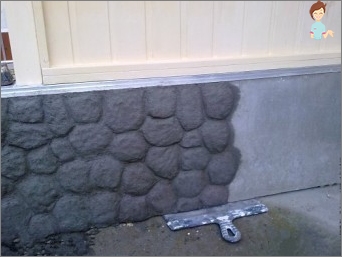 Start any construction work is necessary with preparation. The walls are important to align using stucco or putty. After drying, the place must be processed by the primer.
The next thing to do is to place the laying place. To do this, it is recommended to use a painting tape. It is necessary to apply the finish or starting putty. In the second case, the surface will acquire grain.
It is possible to divide the work on imitation of artificial stone with your own hands into several stages:
- Step number 1. We apply on the wall plaster layer no more than 0.5 cm. It is important that the layer is uniform. Already at this stage it is worth moving to the attachment of the surface of roughness. To do this, you can use any way, for example, a sponge of a foam rubber, roller with a rigid pile and t.D. With the help of the selected item, you must go through the entire surface;
- Step number 2. Draw a seam. Do everything you need quickly so that the plaster does not dry. Use any suitable item to leave the groove of the desired depth. In order not to make a mistake and the final figure was ideal, it is recommended to first outline future lines, for example, with a knife or spatula angle. Observe the chess location. When the work is completed, you need to leave everything dry and after passing the primer;
- Step number 3. Now it remains to decorate the surface to get closer to the appearance of natural material. It is recommended to use acrylic paint or acrylic azure. Color depends on the desired effect. It is important to use a narrow brush to save irregularities. You can first apply white paint and only then the selected option. Such a solution will help to achieve imitation of the erased surface of the stone. After drying, you need to take elastic fine-grained paper and go through the convex surfaces. At the last stage, the wall must be covered with special wax.
How to make imitation of decorative stone with your own hands using forms?
Recently, more and more people choose this particular option, since it is simple and only a few secrets should be known to obtain the desired result. To date, there is a huge number of forms that make it possible to achieve different effects.
The vibrolite method is used, due to which the liquid solution acquires a certain form. If the material is used inside the building, then take a gypsum solution, and for external use it is worth choosing a cement option.
It is possible to use silicone, plastic and polyurethane forms to simulate their own hands. The choice is directly related to the scope of application of the finished cobblestone. So, silicone forms allow you to make a blocking.
Consider the manufacturing process from plaster. To make an artificial cobblestone, such materials are needed:
- bucket;
- Drill with a nozzle;
- gypsum;
- form.
The form pre-cover the separation composition so that in the end it was easy to pull the dried tile. Pour water in bucket, add plaster and mix using a drill with an appropriate nozzle. To increase strength it is recommended to add about 10% sand.
The ratio of plaster and liquid, it is worth choosing yourself. The final consistency should not be liquid. After that, fill the mixture into the form, cover the corrugated glass and leave until complete drying.
Creating a decorative boulder with your own hands
Big cobblestones make it possible to decorate the garden, as well as make artificial reservoirs, fountains and other designs.
For work requires such materials:
- Wire mesh;
- Cement and sand solution in the proportion of 1: 3;
- Film for solution;
- Polyfoam and packages.
Using a grid, you need to make a frame of boulder. Put the foam and crumpled packages inside it. It is important that the final weight was small, and also it reduces the risk of surface failure. Prepare a solution from a piece of cement and three parts of the sand.
The amount of water should be so that the composition is not liquid. Then with hands with small pellets apply the solution to the prepared frame. It is important to leave the first layer to completely dry.
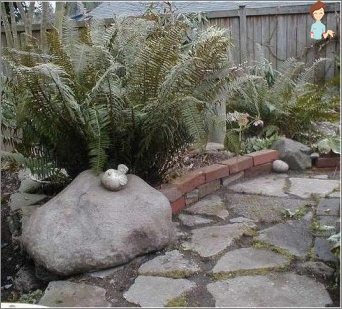 At the next stage, make a more liquid composition and dear the boulder, forming the depressions and bulges. After that, cover everything with the film and leave to stick. Then turn over and do the bottom. To achieve naturalness, use a special pigment.
Sprinkle a boulder with a pigment first, and then dark, spray with water and, using a brush, secure the pigment. Repeat the procedure several times. The last stage – applying sealant to protect the boulder from the influence of external factors.
We reviewed the most popular and simple facilities for the manufacture of artificial stone. Observing all the recommendations, you can create decorative elements with your own hands for your home. A little practice and the desired result will be achieved!